

















Tilly Hill's World War I scrapbook
Transcription
Transcription history
-
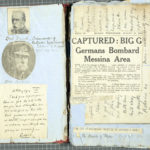
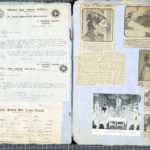
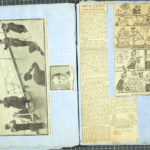
Left Page:
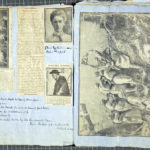
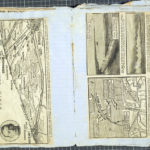
At the top of the page is a political cartoon of a tall angry sailor looking down on a small man in a suit and top hat
LORD LANSDOWNE - "Don't you think you might discount the freedom of the
[ ] with the nice kind Hen.?"
JACK - "Let the blighters come out, and we'll discuss it alright!"
On the left side is a newspaper article:
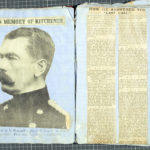
GERMAN VIEW OF LORD
KITCHENER.
-----------
[ ] ASSOCIATION WAR SPECIALS
AMSTERDAM, WEDNESDAY.
The Cologne Gazette prints a short article
on Lord Kitchener, in which the journal
remarks that the man who is commanding the
armies against Germany deserves all the more
attention because nothing much is known
about his personality. British Generals, the
journal says, are not in the habit of enlightening
the world with all sorts of details about
themselves. Kitchener, the Cologne Gazette
continues, is taciturn even for an Englishman.
Moreover, he does not pay over-frequent
visits to the British troops in France,
but prefers to remain in Whitehall at the
War Office, whence he controls the enormous
war machine which he is hurling against us
from all the corners of the globe, and which
he has in the first place to piece together.
It is the historic experience in all British
wars that their organization is never ready at
the beginning of operations, and that the real
preparations have always to be begun after
the outbreak of [ ] . Field-Marshal
Horatio Herbert Kitchener is the embodiment
of British will-power, British toughness, and
British concentration. We do not know
whether he has accepted the task of fighting
the German nation in arms with pleasure.
He is in no way equal to the undertaking, because
he lacks the first quality of the great
General - namely, the psychological sense.
Kitchener does not possess the slightest
understanding of the souls of the people he is
fighting or controlling. He is the personification
of the soulless British Imperial machine
which wages war by means of bargains and
intrigues. It is for that very reason that his
compatriots believe in him. Personally,
Kitchener is said to have one riding passion -
the collection of old skins , and this ceramic
love is perhaps the only close bond which
connects him with humanity.
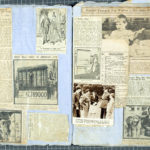
In the center right is a newspaper article:
Armstrong Pratt, dearly loved son of M

Pratt, killed in France, and Mr. T. Pattison
who was lost in the "Leinster." And now just
as these notes go to Press come tidings that
Lieutenant Frank Walkey, younger son of Mr.
and Mrs. C. H. Walkey, and only brother of
Lieutenant Colonel Walkey, has been killed in
France. He was not yet 23 years of age,
and was one of Dublin's best gifts to
the Army. Much sympathy is felt for all the
sorrowing circles, and also for Mr. and Mrs.
Semple, of the Rathgar Division of the same
Circuit, in the loss of their bright boy through
the prevailing epidemic.
In the lower right is a newspaper clipping of an aerial view of a town, focusing on a large ornate building:
DESTRUCTION OF RHEIMS AT LAST COMPLETED.
As it is in anger at the appalling cost of its inconclusive push on the western front,
German command has set to work to reduce Rheims and its famous cathedral to ru
The civil population, which numbered 120,000 in time of peace, is now altogether g
German kultur has added another atrocity to its list of horrors.
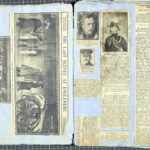
Right Page:
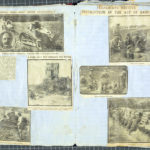
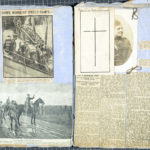
Oriented horizontally at the top of the page is a newspaper clipping of an image of people and horses trudging through what looks like a storm and high winds
The March Of The British Nurses.
The march of the Scottish nurses over the Albanian mountains during their retreat from
Serbia is a marvellous story of women's pluck and endurance.
--(Reproduced by courtesy of The Sphere.)
Below center is a newspaper clipping of an image of soldiers in battle with the caption:
On the top of the ridge, which was bought with such splendid daring and at such
great loss by the Australian troops.
Center right newspaper clipping:
JANUARY
8
Evocation of Gallipoff, 1916.
Man's [ ] duty is everywhere and in all
things go toward the progress of humanity.
Lower right newspaper clipping of a woman's face with the caption:
Miss Moyra Cavanagh, who
received the Military Medal from
the King for bravery and devotion
to wounded during enemy
air raid in France.
-
Left Page:
At the top of the page is a political cartoon of a tall angry sailor looking down on a small man in a suit and top hat
LORD LANSDOWNE - "Don't you think you might discount the freedom of the
[ ] with the nice kind Hen.?"
JACK - "Let the blighters come out, and we'll discuss it alright!"
On the left side is a newspaper article:
GERMAN VIEW OF LORD
KITCHENER.
-----------
[ ] ASSOCIATION WAR SPECIALS
AMSTERDAM, WEDNESDAY.
The Cologne Gazette prints a short article
on Lord Kitchener, in which the journal
remarks that the man who is commanding the
armies against Germany deserves all the more
attention because nothing much is known
about his personality. British Generals, the
journal says, are not in the habit of enlightening
the world with all sorts of details about
themselves. Kitchener, the Cologne Gazette
continues, is taciturn even for an Englishman.
Moreover, he does not pay over-frequent
visits to the British troops in France,
but prefers to remain in Whitehall at the
War Office, whence he controls the enormous
war machine which he is hurling against us
from all the corners of the globe, and which
he has in the first place to piece together.
It is the historic experience in all British
wars that their organization is never ready at
the beginning of operations, and that the real
preparations have always to be begun after
the outbreak of [ ] . Field-Marshal
Horatio Herbert Kitchener is the embodiment
of British will-power, British toughness, and
British concentration. We do not know
whether he has accepted the task of fighting
the German nation in arms with pleasure.
He is in no way equal to the undertaking, because
he lacks the first quality of the great
General - namely, the psychological sense.
Kitchener does not possess the slightest
understanding of the souls of the people he is
fighting or controlling. He is the personification
of the soulless British Imperial machine
which wages war by means of bargains and
intrigues. It is for that very reason that his
compatriots believe in him. Personally,
Kitchener is said to have one riding passion -
the collection of old skins , and this ceramic
love is perhaps the only close bond which
connects him with humanity.
In the center right is a newspaper article:
Armstrong Pratt, dearly loved son of M
Pratt, killed in France, and Mr. T. Pattison
who was lost in the "Leinster." And now just
as these notes go to Press come tidings that
Lieutenant Frank Walkey, younger son of Mr.
and Mrs. C. H. Walkey, and only brother of
Lieutenant Colonel Walkey, has been killed in
France. He was not yet 23 years of age,
and was one of Dublin's best gifts to
the Army. Much sympathy is felt for all the
sorrowing circles, and also for Mr. and Mrs.
Semple, of the Rathgar Division of the same
Circuit, in the loss of their bright boy through
the prevailing epidemic.
In the lower right is a newspaper clipping of an aerial view of a town, focusing on a large ornate building:
DESTRUCTION OF RHEIMS AT LAST COMPLETED.
As it is in anger at the appalling cost of its inconclusive push on the western front,
German command has set to work to reduce Rheims and its famous cathedral to ru
The civil population, which numbered 120,000 in time of peace, is now altogether g
German kultur has added another atrocity to its list of horrors.
Description
Save description- 52.57259130000001||-9.374874500000032||||1
Tarbert, Co, Kerry
Location(s)
Story location Tarbert, Co, Kerry
- ID
- 4450 / 52148
- Contributor
- Mary Lavery Carrig
Login to edit the languages
- English
Login to edit the fronts
Login to add keywords
- Women
Login to leave a note